
The S&P 500 (^GSPC -2.50%) stock market index has more than doubled from its 2022 bear market low point, but it faces a number of challenges that could derail its current bull run.
Rising oil prices are stoking inflation, which prompted the Federal Reserve to raise interest rates at its September meeting, and additional hikes might be on the way. This alone has been enough to spark a correction in the broader market in the past, but investors are also wrestling with a potential slowdown in artificial intelligence (AI) infrastructure spending, which is impacting some of the largest stocks in the S&P 500.
To top things off, the S&P is trading at a very expensive valuation, leaving it particularly vulnerable to a sharp sell-off. Fortunately, there is a way investors can capitalize on a downturn based on almost 70 years' worth of history.
Image source: Getty Images.
The AI boom is on a collision course with rising interest rates
The U.S. and Iran have been engaged in a geopolitical conflict since February, resulting in the closure of the Strait of Hormuz waterway, through which 25% of the world's seaborne oil transits each day. Moreover, the ongoing war between Saudi Arabia and Yemen recently knocked even more oil supply offline, while Ukraine and Russia also continue targeting one another's energy infrastructure.
As a result, West Texas Intermediate crude oil now trades for over $100 per barrel, a sharp increase from its 2026 opening price of $57. It's feeding through to the cost of refined products like gasoline, diesel, and jet fuel, so consumers are dealing with higher prices for practically every product that travels by truck, boat, or plane. This is stoking inflation, with the Consumer Price Index (CPI) rising at an annualized rate of 3.7% in September, far above the Federal Reserve's target of 2%.
That was behind the Fed's decision to raise interest rates by 25 basis points at its September meeting, and Wall Street is pricing in one more hike before the end of 2026, according to the CME Group's FedWatch tool.
Rising interest rates force consumers to allocate more of their household budgets to debt repayments, leaving less money for discretionary spending, which negatively impacts corporate earnings. Moreover, companies think twice about borrowing money to fund expansion when rates are high, so investors start pricing in slower growth, which also weighs on stock market valuations.
Plus, rising rates increase the yield on risk-free assets like cash and government Treasury bonds, providing an attractive alternative to more volatile growth assets like stocks and real estate.
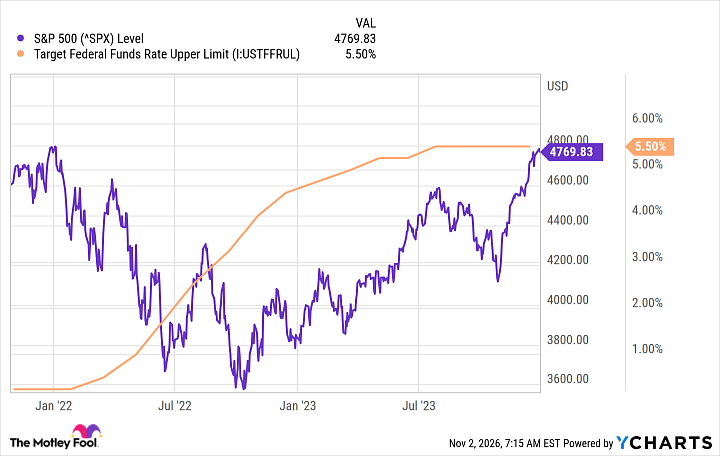
That is why interest rates are so important for the stock market. During the Fed's last rate-hiking cycle, which spanned from March 2022 to August 2023, the S&P 500 suffered a bear-market decline of more than 20%.
But stocks might be especially sensitive this time around because of the AI industry's mind-boggling funding requirements. Tech companies are borrowing hundreds of billions of dollars to fund the construction of data centers, and many at the smaller end of the spectrum (like CoreWeave) have recently experienced a sharp spike in interest rates as investors worry about their ability to repay the money.
The technology sector makes up 38% of the S&P 500, so the index could certainly suffer another bear-market decline if rising borrowing costs start to derail data center projects on a large scale.
History suggests investors should do this
The S&P 500 is trading at a Shiller Cyclically Adjusted Price-to-Earnings (CAPE) ratio of above 40 for only the second time in its history. The first was during the dot-com internet bubble in the leadup to the year 2000, and when it eventually burst, the index plummeted by a whopping 49%. I'm not predicting a similar decline this time, but high valuations do make the market especially vulnerable to downside.
Today's Change
Index Level
7,496.67
But it's important to remember that volatility is a normal part of the investing journey. It's the price of admission for an opportunity to earn substantial long-term returns. In fact, according to Capital Group, the S&P 500 suffers a bear-market decline of 20% (or more) every six years, on average, and four years have already passed since the last one.
What should investors do if the stock market crashes? The S&P 500 has delivered a compound annual return of 10.7% since it was established in 1957, even after factoring in every sell-off, correction, and bear market during the last 69 years. Therefore, if an investor buys an S&P 500 index fund at the absolute top of the current bull market, history suggests they will eventually come out ahead if they just stay the course.
Getting out of the market in a panic is the absolute worst move investors can make. Instead, buying stocks during the most nerve-wracking moments would have yielded fantastic results over the last seven decades, and that will almost definitely be the case again when the next crash arrives.





 English (US) ·